
research driven mathematics
From Foundation to Fluency
Explore our math program to discover how our 5-Pillar framework builds deep conceptual understanding—and transforms frustration into lasting confidence.
mechanics of mathematics
Why Math Learners Get Stuck
When children freeze up on multi-step word problems, rely endlessly on finger-counting for basic facts, or spend hours on homework only to forget the steps the next day, it is not a reflection of their intelligence or mathematical ability.
Cognitive science shows that mathematical reasoning relies on building strong mental models by systematically bridging concrete hands-on experiences to abstract symbols (Ebner et al., 2025; Agrawal & Morin, 2016). When instruction moves too quickly to abstract methods before conceptual understanding is secure, or when basic facts aren’t yet automatic, a child’s brain exhausts its limited working memory capacity just trying to compute individual numbers—leaving little to no cognitive space for problem-solving, spatial reasoning, or higher-order logic (Sweller et al., 2019; Fuchs et al., 2008).
References
Ebner, S., MacDonald, M. K., Grekov, P., & Aspiranti, K. B. (2025). A meta-analytic review of the Concrete-Representational-Abstract math approach. Learning Disabilities Research & Practice, 40(1), 45–58.
Sweller, J., van Merriënboer, J. J., & Paas, F. (2019). Cognitive load theory: Methods to manage working memory load in instruction. Educational Psychology Review, 31(2), 261–292.
Agrawal, J., & Morin, L. L. (2016). Evidence-based practices: Applications of the Concrete-Representational-Abstract framework across math concepts. Intervention in School and Clinic, 52(1), 34–45.
Fuchs, L. S., Fuchs, D., Powell, S. R., Seethaler, P. M., Cirino, P. T., & Fletcher, J. M. (2008). Intensive intervention for students with mathematics disabilities: Seven principles of effective practice. Learning Disability Quarterly, 31(2), 79–92.

Unsure where your child’s math breakdown is occurring?
Grounded in Evidence-Based Pedagogy
Our 5 Core Pillars
By replacing rote memorization with explicit visual models, systematic concrete-to-abstract progression, and continuous mastery tracking, our five core pillars eliminate cognitive overload—unlocking your child’s working memory to focus on deep conceptual understanding, strategic reasoning, and fluent problem-solving.

01
Concrete-Representational-Abstract (CRA) Sequence
Systematic meta-analyses confirm that transitioning students sequentially through concrete manipulatives, visual representations, and abstract mathematical notation generates significantly higher retention and conceptual mastery across all K–8 domains (Ebner et al., 2025; Agrawal & Morin, 2016).
We build math concepts from the ground up rather than jumping straight to abstract symbols. Students manipulate physical materials to understand quantity and operations, transition to visual models and bar diagrams, and finally apply abstract formulas with total clarity.
02
Guided Practice & Micro-Step Scaffolding
Cognitive Load Theory demonstrates that breaking complex mathematical procedures into tightly scaffolded, incremental steps and providing explicit, guided practice prevents working memory overload and builds true procedural independence (Sweller et al., 2019; Fuchs et al., 2008).
We structure complex problem-solving into manageable, micro-step sequences supported by direct instruction and guided modeling. By providing explicit instruction and immediate feedback at each step, we eliminate frustration, ensure success at every stage, and systematically build independent problem-solving confidence.


03
Computational Automaticity & Fact Fluency
Neurological research shows that achieving automaticity in basic math facts frees critical working memory capacity, enabling students to process multi-step algorithms and complex word problems without cognitive delay (Fuchs et al., 2008).
We develop fast, accurate recall of foundational facts through pattern-based strategies and targeted practice rather than stressful timed drills. Solidifying basic facts gives students the cognitive bandwidth needed to tackle multi-step reasoning with speed and confidence.
04
Spatial & Visual-Mathematical Reasoning
Empirical studies confirm that spatial reasoning skills—such as visual decomposition, array modeling, and number-line positioning—directly predict overall mathematical achievement and algebraic readiness (Mix et al., 2016; Geary, 2013).
We teach students to visualize mathematics beyond numerical figures. Using number lines, area models, and spatial arrays, learners develop flexible mental models that make abstract concepts—like fractions, place value, and proportional reasoning—intuitive and concrete.
05
Integrated Problem-Solving & Mathematical Communication
Research highlights that explicitly articulating mathematical reasoning—both verbally and in writing—strengthens conceptual retrieval, bridges procedural gaps, and deepens analytical reasoning (Woodward et al., 2012).
We connect math mechanics directly to real-world application and verbal articulation. Students learn to explain why an answer makes sense, evaluate multiple strategies for a single problem, and confidently apply their skills to unfamiliar context-rich scenarios.
References
Agrawal, J., & Morin, L. L. (2016). Evidence-based practices: Applications of the Concrete-Representational-Abstract framework across math concepts. Intervention in School and Clinic, 52(1), 34–45.
Ebner, S., MacDonald, M. K., Grekov, P., & Aspiranti, K. B. (2025). A meta-analytic review of the Concrete-Representational-Abstract math approach. Learning Disabilities Research & Practice, 40(1), 45–58.
Fuchs, L. S., Fuchs, D., Powell, S. R., Seethaler, P. M., Cirino, P. T., & Fletcher, J. M. (2008). Intensive intervention for students with mathematics disabilities: Seven principles of effective practice. Learning Disability Quarterly, 31(2), 79–92.
Geary, D. C. (2013). Early foundations for mathematics learning and their relations to learning disabilities. Current Directions in Psychological Science, 22(1), 23–27.
Mix, K. S., Levine, S. C., Cheng, Y. L., Young, C., Hambrick, D. Z., Ping, R., & Konstantopoulos, S. (2016). Separate but interconnected: The relation between spatial ability and mathematics ability across development. Journal of Experimental Psychology: General, 145(9), 1206–1227.
Sweller, J., van Merriënboer, J. J., & Paas, F. (2019). Cognitive load theory: Methods to manage working memory load in instruction. Educational Psychology Review, 31(2), 261–292.
Woodward, J., Beckmann, S., Driscoll, M., Franke, M., Herzig, P., Jitendra, A., Koedinger, K. R., & Ogbuehi, P. (2012). Improving mathematical problem solving in grades 4 through 8 (NCEE 2012-4003). Washington, DC: National Center for Education Evaluation and Regional Assistance, Institute of Education Sciences, U.S. Department of Education.
Ready to build your child’s math confidence?
The mindbuilders Roadmap
Our 9-Tier Math Roadmap
Our 9-Tier Math Roadmap replaces age- and grade-based benchmarks with strict mastery-based progression. Grounded in cognitive load theory and the Concrete-Representational-Abstract (CRA) sequence, students advance to higher-level abstract reasoning only after demonstrating complete automaticity and conceptual fluency at their current tier.
Tier 1

Early Numeracy & Spatial Foundations
Learners build foundational number sense by connecting physical quantities to visual representations, mastering subitizing, set comparison, and spatial relationships.
Tier 2

Additive Structures & Base-Ten Mechanics
Learners master place value concepts and part-whole number decomposition, establishing fast automaticity in single-digit addition and subtraction.
Tier 3

Multi-Digit Operations & Place Value Systems
Learners extend place value mechanics to multi-digit numbers, applying visual array models and column regrouping to addition and subtraction with total procedural clarity.
Tier 4

Multiplicative Thinking & Operational Fluency
Learners transition from additive to multiplicative reasoning, securing computational automaticity in multiplication and division facts through equal groups, arrays, and area models.
Tier 5

Rational Numbers & Part-Whole Structures
Learners develop a deep conceptual understanding of fractions and decimals by manipulating visual area models, identifying equivalence, and mastering spatial scale.
Tier 6

Fractional Arithmetic & Dimensional Measurement
Learners execute precise calculations across mixed fractions and decimals while applying visual geometry concepts to perimeter, area, and 3D volume.
Tier 7

Proportional Reasoning & Variable Relationships
Learners master multiplicative comparisons, ratios, unit rates, and negative integers, applying proportional logic to coordinate planes and percentage problems.
Tier 8

Pre-Algebraic Systems & Linear Expressions
Learners bridge numerical operations to algebraic thinking by evaluating multi-step linear equations, applying order of operations, and manipulating unknown variables.
Tier 9

Functional Modeling & Advanced Problem-Solving
Students synthesize advanced algebraic, spatial, and functional concepts (y = mx + b), independently translating complex real-world scenarios into formal mathematical models.
Discover your child’s exact entry point on our 9-Tier Roadmap.
how it works
Our Intervention Process
From initial diagnostic placement to ongoing mastery tracking and family updates, our structured workflow ensures a seamless, transparent experience. Every step is designed to deliver targeted, high-impact instruction tailored strictly to your child’s exact skill level.
01

Our Diagnostic Assessment
Before instruction begins, we conduct a low-stress, multi-sensory math assessment to pinpoint your child’s exact entry point on our 9-Tier Roadmap. Our diagnostic isolates specific computational, spatial, and conceptual breakdowns across foundational mechanics—allowing us to target the root cause of math frustration from day one.
02

Targeted Roadmap Placement
Based on diagnostic results, we place your child at their precise point of need on our 9-Tier Math Roadmap. By bypassing age- and grade-based assumptions, we build a customized learning plan that systematically targets skill gaps while pacing advanced concepts at a rate that maintains total engagement.
03
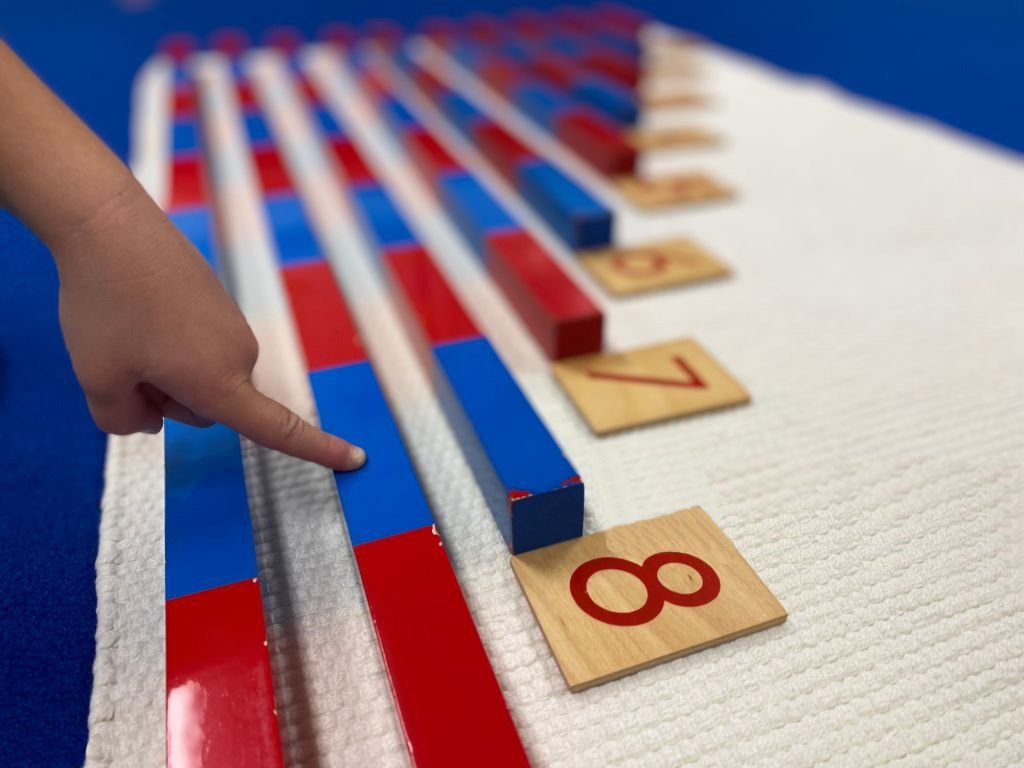
Structured Multi-Sensory Instruction
In every session, instruction moves systematically through the Concrete-Representational-Abstract (CRA) sequence. Using physical manipulatives, visual area models, number lines, and micro-step scaffolding, we ensure your child fully grasps the mathematical logic behind every concept before transitioning to abstract paper-and-pencil work.
04

Continuous Mastery & Automaticity Tracking
We measure progress through continuous micro-assessments and embedded mastery gates at every tier. By ensuring basic fact recall and procedural steps become fully automatic before introducing more complex topics, we protect your child’s working memory from cognitive overload and ensure long-term retention.
05

Transparent Family Progress Updates
Families receive clear, objective progress updates detailing specific skills mastered and roadmap placement. We equip you with simple strategies and direct feedback to support your child’s growing confidence at home. This transparent communication keeps you fully informed and empowered as your child advances.
Take the first step toward lasting mathematical confidence.
Schedule a diagnostic discovery session to receive a custom roadmap for your child.
Get in Touch
Contact Us

Phone
Mon–Fri 9:00 a.m. – 3:00 p.m.

We reply within 24 hours
